
Blog · July 27, 2026 · 9 min read
How to advertise a crypto project in 2026
A practitioner's guide to crypto advertising: defining conversions, targeting onchain behavior, what each channel is honestly good for, and measuring lift instead of luck.
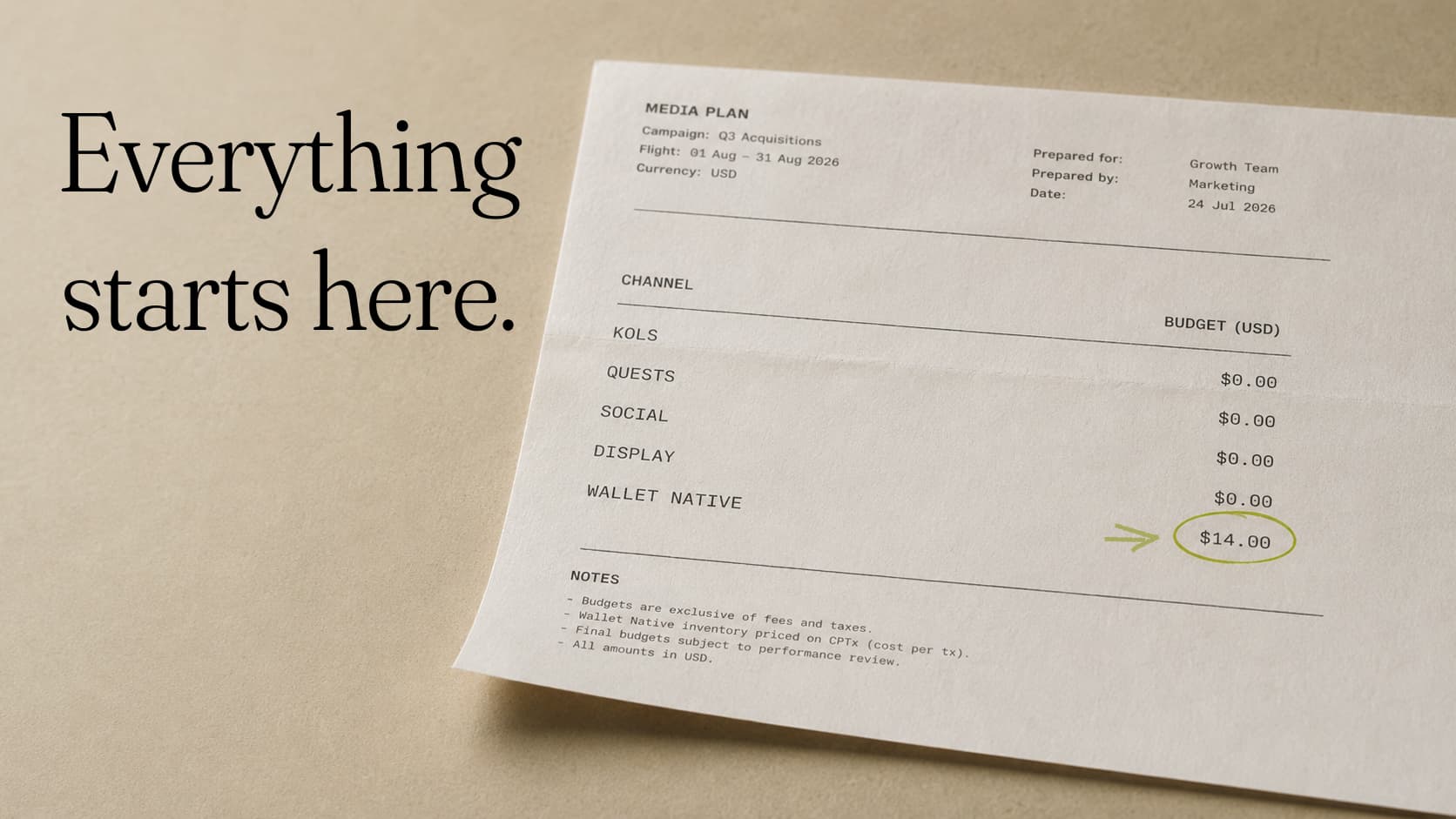
Most crypto ad budgets die the same death: money goes out, a dashboard fills with impressions, Discord gets slightly busier for a week, and nobody can say what actually happened. The teams that escape this do not have better creative or bigger budgets. They decide, before spending anything, what a conversion is and how they will know the ad caused it. Everything else in this guide hangs off that.
Start from the conversion, not the channel
“Awareness” is not a goal a protocol can bank. Pick the onchain action that makes a user valuable to you: a first swap, a deposit over some threshold, liquidity that stays for a month. Give it a value. If a converted user is worth $200 in fees over a year, you can afford a real acquisition cost, and every channel conversation becomes arithmetic instead of vibes. If you cannot value the action yet, run a small test to find out. Do not scale spend before this number exists.
Target behavior, not demographics
Web3 has a strange advantage over every other advertising market: your ideal customers are walking around with their history in public. Someone who provides liquidity on a competitor, holds wBTC, or trades perps weekly has told you exactly what they are. Interest-based targeting (“crypto enthusiasts, 25 to 44”) throws that away and buys you students who once googled bitcoin. Whatever channel you use, push it to target observed onchain behavior. If it cannot, price that blindness into what you pay.
The channels, honestly
Every channel below works for someone. The failure mode is using one for a job it does not do.
- KOLs and influencers. Good for launches and narrative moments; the spike is real. The problem is that the spike is all you can see: attribution is a guess, pricing is a negotiation, and the audience overlap between ten crypto KOLs is enormous. Treat it as PR with reach, not as an acquisition channel.
- Quest platforms and airdrop campaigns. They deliver exactly what they measure: task completions. Wallets show up, do the minimum, and leave when the reward ends. If your goal is durable users, count how many questers remain active after 30 days before calling it acquisition.
- X and mainstream social ads. Reach is huge, crypto policy enforcement is moody, and the targeting knows interests, not wallets. Fine for consumer-facing brands with broad funnels; rough for a DeFi protocol whose entire market is maybe two million active wallets. (Google deserves its own discussion; we wrote a separate piece on it.)
- Crypto display networks. Banners on crypto media sites, bought per impression. Cheap reach in-context, and honest sellers of what they are. You still carry the measurement problem yourself, and banner blindness in this audience is severe.
- Wallet-native, conversion-billed networks. Ads inside wallets, explorers, and apps people already use, targeted by onchain behavior, and, in Specify’s case, billed only when a verified onchain conversion happens. The trade-off is honesty in the other direction: volume is bounded by how many genuinely matching users exist, so it will not flood your top of funnel. It converts the middle of it.
For a fuller comparison of the networks in that last two categories, see our rundown of crypto ad networks.
Make creative for people who hate ads
Crypto natives run ad blockers, distrust everything, and have seen every “10x your yield” banner ever made. What works looks less like advertising and more like a recommendation: name the concrete thing (“7.2% on stables, withdrawals anytime”), show the product surface, skip the rocket emojis. The best performing creative we see reads like something a sharp friend would DM you, not something a brand would post.
Measure like a skeptic
Two practices separate teams that learn from teams that burn. First, insist on conversions you can verify, which in web3 means onchain attribution rather than pixel faith. Second, run an incrementality holdout: keep an identical audience unexposed and compare. Crypto audiences convert organically all the time, and without a holdout your report will happily bill you for users you already had. When CoW Swap ran this properly, exposed users converted at 6x the rate of the holdout, which is the difference between knowing and hoping.
Spend like a scientist
The sequence that works: run a small structured test, read the report, kill what failed, scale what proved. The sequence that fails: commit a quarter’s budget to a channel because a competitor seemed to be everywhere that month. Specify’s version of the first sequence is a $1,000 test campaign with a calibration flight and a report you keep either way, but the principle holds on any channel: buy information first, volume second.