
Blog · July 27, 2026 · 5 min read
What is incrementality in advertising?
Incrementality measures the conversions your ads actually caused, by comparing exposed users against an identical holdout that never saw the campaign. Here is how to run and read one.
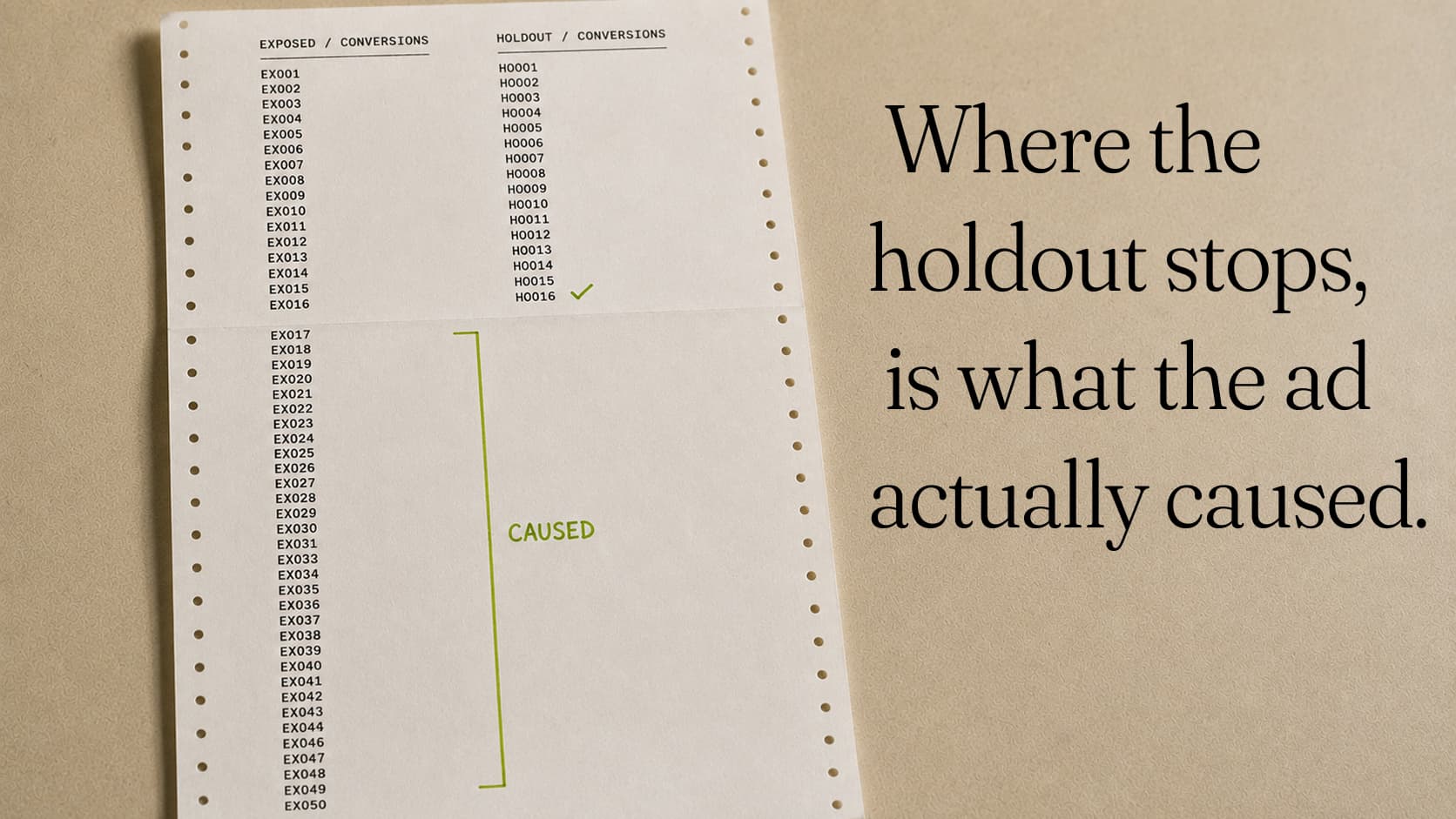
Incrementality is the share of conversions that happened because of your advertising, measured by comparing exposed users against an identical holdout group that never saw the ads. If the exposed group converts at 3% and the holdout at 1%, the campaign caused the difference: a 3x lift, with two thirds of exposed conversions being incremental.
Why attribution alone lies to you
Standard attribution answers a weaker question: which ad touched the user last before they converted. In crypto this goes wrong constantly. Your most reachable audience is also your most likely to convert anyway: active wallets, existing community members, people who were three Discord messages away from depositing regardless. An ad shown to them “converts” on paper while changing nothing in reality. Last-click attribution bills you for the harvest; incrementality asks whether you planted anything.
How a holdout test works
- Build the target audience, then randomly split it before the campaign starts. One group sees the ads; the holdout sees nothing.
- Run the campaign long enough for the conversion window to breathe. Fourteen days of attribution needs more than fourteen days of patience.
- Compare conversion rates between the groups. The ratio is your lift; exposed minus holdout, over exposed, is the fraction of conversions that were truly incremental.
The onchain setting makes this unusually clean. Both groups’ conversions are visible on public chains as verified onchain conversions, so nobody is comparing a pixel’s opinion against a spreadsheet. When CoW Swap ran their campaign this way, exposed users converted at 6x the holdout rate, alongside 1,500+ verified conversions and more than $50M in attributed volume. The full methodology is in the case study.
Reading the number
A lift of 1x means the ads did nothing: everyone who converted would have anyway. Between 1x and 2x, the channel works but the economics need checking against what an incremental conversion costs. Above that, you have found something worth scaling, and the interesting question becomes whether lift holds as you widen the audience (usually it compresses at the edges, which is normal, not failure).
Quick answers
Does a holdout waste budget? No; it reallocates a slice of reach into certainty. Spending 100% of budget on unmeasurable delivery wastes more.
When is it overkill? Below a few hundred expected conversions the comparison gets noisy. For small tests, verified conversions plus honest cohort tracking beat a statistically shaky lift number.
Who should run one? Anyone about to scale a channel. It is the difference between a report that says “attributed 1,000 conversions” and one that says “caused 800”. Specify runs holdouts as part of campaign measurement, starting with the $1,000 test.